|
Ammonia production. Ammonia-nitrogen is a major end product of fish metabolism. Ammonia is produced from the breakdown of protein to supply energy needs. Dietary protein is used by fish to supply essential amino acids (those which fish cannot synthesize) required for growth and is used to supply energy needs. Ammonia is excreted passively and actively across the gills and is oxidized by aerobic nitrifying bacteria to nitrite and nitrate. In aqueous solution, ammonia exists in an equilibrium of the unionized form (NH3) with the ionized form (NH4+) and the hydroxide ion (OH-). Water pH has the greatest effect on this equilibrium, though temperature and ionic strength also contribute (Messer et al. 1984; Thurston et al. 1981a; Emerson et al. 1975). Increasing pH shifts the equilibrium towards unionized ammonia (NH3). This must be considered since the relative toxicity of the two species is different. The unionized form is considered more toxic since it can diffuse passively across the gill membrane. Mechanisms of Toxicity. Several suggested mechanisms of ammonia toxicity reviewed and summarized by Ruffer (1981) include: gill damage leading to suffocation, osmoregulation dysfunction (bloating) causing kidney failure, and inhibition of ammonia excretion leading to neurological and cytological failure. Many studies into mechanisms of ammonia toxicity do not account for synergistic effects of ammonia and other metabolic products or variables such as: dissolved oxygen, carbon dioxide, alkalinity, calcium, and acclimation (Meade 1985). These factors have been shown to alter ammonia toxicity and their effects continue to be the topic of some investigation.
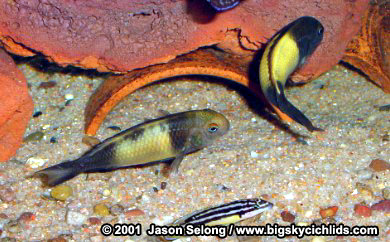
Tropheus spp. appear to be among the most sensitive to dissolved metabolites among African cichlids.
Lethal and Sublethal Ammonia. Studies of ammonia toxicity in fish have been primarily conducted on commercially important game or aquaculture species (e.g. trout, salmon, catfish, bass) (Colt and Armstrong 1981). Researchers have noted increased toxicity as pH increased and concluded the unionized form is more toxic since the equilibrium shifted towards a higher fraction of unionized ammonia at elevated pH (Meade 1985). Interestingly, acclimation to low and fluctuating levels of ammonia has been shown to increase acute lethal toxicity in fish (Thurston et al. 1981b). Chronic exposure to sublethal concentrations of ammonia has not been widely researched. Sublethal effects include reduced growth, destruction of gill tissue, and increased susceptibility to disease (Soderberg et al 1983).
Synergistic effects. Ammonia toxicity has been shown to increase as dissolved oxygen levels are reduced (Thurston et al. 1981c). Calcium (added as CaCl) has been shown to have a protective effect against ammonia toxicity in channel cats and sunshine bass (Tomasso et al. 1980; Weirich et al. 1993). This result is not altogether surprising since calcium is known to decrease membrane permeability and has been shown to reduce the toxicity of several metals (McDonald et al. 1989). Decreasing gill membrane permeability would lower ion regulation dysfunction which may be one of the contributing factors of ammonia toxicity (Tomasso et al. 1980). The relationship of carbon dioxide concentration and temperature on ammonia toxicity are poorly understood and consistent effects on toxicity have not been shown (Meade 1985).
Cichlid ammonia sensitivity. Though lethal and sublethal effects of ammonia have not (to my knowledge) been researched in cichlids, observations suggest differences among cichlid species. Cichlids seem, with a few exceptions, fairly tolerant of the stresses presented by closed systems (e.g. aquariums) relative to other families of freshwater fish (e.g. salmonidae, percidae) . The notable exceptions are the Tanganyikan Tropheus spp. and many of the Malawi mbuna. These groups of cichlids seem most affected by water quality, particularly post feeding (e.g. behavior including scratching and shimmy), suggesting a sublethal effect of ammonia. Continued exposure to sublethal levels of ammonia and stress from the particularly high level of inter-specific aggression shown by most of these species may lead to a general failure to maintain body regulation resulting in bloating or disease often seen in these species.
Practical Applications. Ammonia levels rise in response to feeding as fed protein is broken down to provide energy. Ammonia, excreted primarily across the gills, may become more difficult to passively excrete as concentrations within the aquarium rise. Increased sublethal levels of ammonia may be responsible for the peculiar behavior of fish including shimmy and scratching gill opercula on rocks particularly after heavy feedings. Efficient biological filtration reduces ammonia concentrations rapidly. Filters from simple air driven sponges to under-gravel, box power filter, wet/dry, and fluid bed provide surface area for colonization of aerobic bacteria that oxidize ammonia. This article will not attempt to discuss the relative merits of a particular filter type, though remember that providing the highest level of surface area and largest volume of circulation is an important factor in rapidly reducing ammonia levels. Filtration units should also include a pre-filter to prevent debris from fouling the biological filter and promoting the growth of heterotrophic bacteria which will compete with the nitrifying bacteria. In intensive recirculating aquaculture facilities ammonia, in some cases, is oxidized rapidly by efficient biological filtration and lethal and sublethal toxicity of nitrite have been reported to be more of a problem than ammonia (Weirich et al. 1993 ). Feed management may also effect ammonia levels. Aquarium fish, and cichlids in particular, are often feed heavily to promote growth, reproduction, and perhaps reduce aggression. Feedings may be spaced such that the same ration is fed only over several more feedings. This type of feed management would reduce peak ammonia levels during any one feeding. An automatic feeder may help facilitate this type of feeding. Maintaining a pH in the neutral to slightly alkaline range (7.0-8.0) may also reduce ammonia toxicity. At higher pH, the equilibrium of aqueous ammonia shifts to largely unionized ammonia which has been shown to be more toxic to fish. Water changes are also of primary importance in maintaining water quality within an aquarium. Water changes remove the end product of nitrification, nitrate, as well as accumulated solid waste products (detritus), replenish some trace minerals, and reduce stress on aquarium inhabitants. In my experience efficient filtration, and large (50-70%) weekly water changes allows heavy feeding (53% protein feed) with all types of cichlids (Tropheus spp. included!).
Literature Cited
Colt, J.E. and D.A. Armstrong. 1981. Nitrogen toxicity to crustaceans, fish, and molluscs. pp.34-37 in L.J. Allen & E.C. Kinney, eds. Proceedings of the bio-engineering symposium for fish culture. American Fisheries Society, Bethesda, MD.
Emerson, K.R., R.C. Russo, R.E. Lund, & R.V. Thurston. 1975. Aqueous ammonia equilibrium calculations: effect of pH and temperature. Journal of Fisheries Research Board of Canada 32: 2379-2383.
McDonald, D.G., J.P. Reader, & T.R.K. Dalziel. 1989. The combined effects of pH and trace metals on fish ionregulation. pp.221-242 in R. Morris, E.W. Taylor, D.J.A. Brown, J.A. Brown, eds. Acid Toxicity to Aquatic Animals Cambridge University Press, Cambridge.
Meade, J.W. 1985. Allowable ammonia for fish culture. Progressive Fish Culturist 47: 135-145.
Messer, J.J., J. Ho, & W.J. Grenney. 1984. Ionic strength correction for extent of ammonia ionization in freshwater. Canadian Journal of Fisheries and Aquatic Science 41: 811-815.
Ruffer, P.J., W.C. Boyle, & J. Kleinschmidt. 1981. Short-term acute bioassays to evaluate ammonia toxicity and effluent standards. Journal of the Wastewater Pollution Control Federation 53: 367-377.
Soderberg, R.W., J.B. Flynn, & H.R. Schmittou. 1983. Effects of ammonia on growth and survival of rainbow trout in intensive static-water culture. Transactions of the American Fisheries Society 112: 448-451.
Thurston, R.V., R.C. Russo, ,and G.A. Vinogradov. 1981a. Ammonia toxicity to fishes. The effect of pH on the toxicity of the un-ionized ammonia species. Environmental Science and Technology 15: 837-840.
Thurston, R.V, C. Chakonmakos, & R.C. Russo. 1981b. Effect of fluctuation exposures on the acute toxicity of ammonia to rainbow trout (Salmo gardneri) and cutthroat trout (Salmo clarki). Water Research 15: 911-917.
Thurston, R.V., G.R. Phillips, R.C. Russo, & S.M. Hinkins. 1981c. Increased toxicity of ammonia to rainbow trout (Salmo gairdneri) resulting from reduced concentrations of dissolved oxygen. Canadian Journal of Fisheries and Aquatic Science 39: 983-988.
Tomasso, J.R., C.A. Goudie, B.A. Simco, & K.B. Davis. 1980. Effects of environmental pH and calcium on ammonia toxicity in channel catfish. Transactions of the American Fisheries Society 109: 229-234.
Weirich, C.R., J.R. Tomasso, & T.I.J. Smith. 1993. Toxicity of ammonia and nitrite to sunshine bass in selected environments. Journal of Aquatic Animal Health 5: 64-72.
|

|
Home l Update l Stock List l Gallery | Lake Malawi l Lake Tanganyika l Lake Victoria l Articles l References l Links l About | Contact
|
